


Have you ever felt irritated with someone, only to realize later that you were actually hurt? Or perhaps you’ve noticed yourself becoming anxious at the thought of disappointing someone, even when you know that saying no would be perfectly reasonable.
Sometimes, our emotional responses can be confusing. We may feel one thing on the surface while something quite different is happening underneath. At other times, we might find ourselves repeatedly analyzing an experience without understanding why it bothers us.
The truth is, understanding what we feel isn’t always straightforward. Our emotional experiences are shaped by many things: our temperament, relationships, personal histories, and the ways we’ve learned to respond to difficult situations.
While we might like to think of ourselves as rational beings who understand why we do what we do, much of our emotional life unfolds outside our immediate awareness.
One framework I’ve found particularly useful for making sense of these experiences is the Change Triangle, developed by psychotherapist Hilary Jacobs Hendel.
What is the Change Triangle?
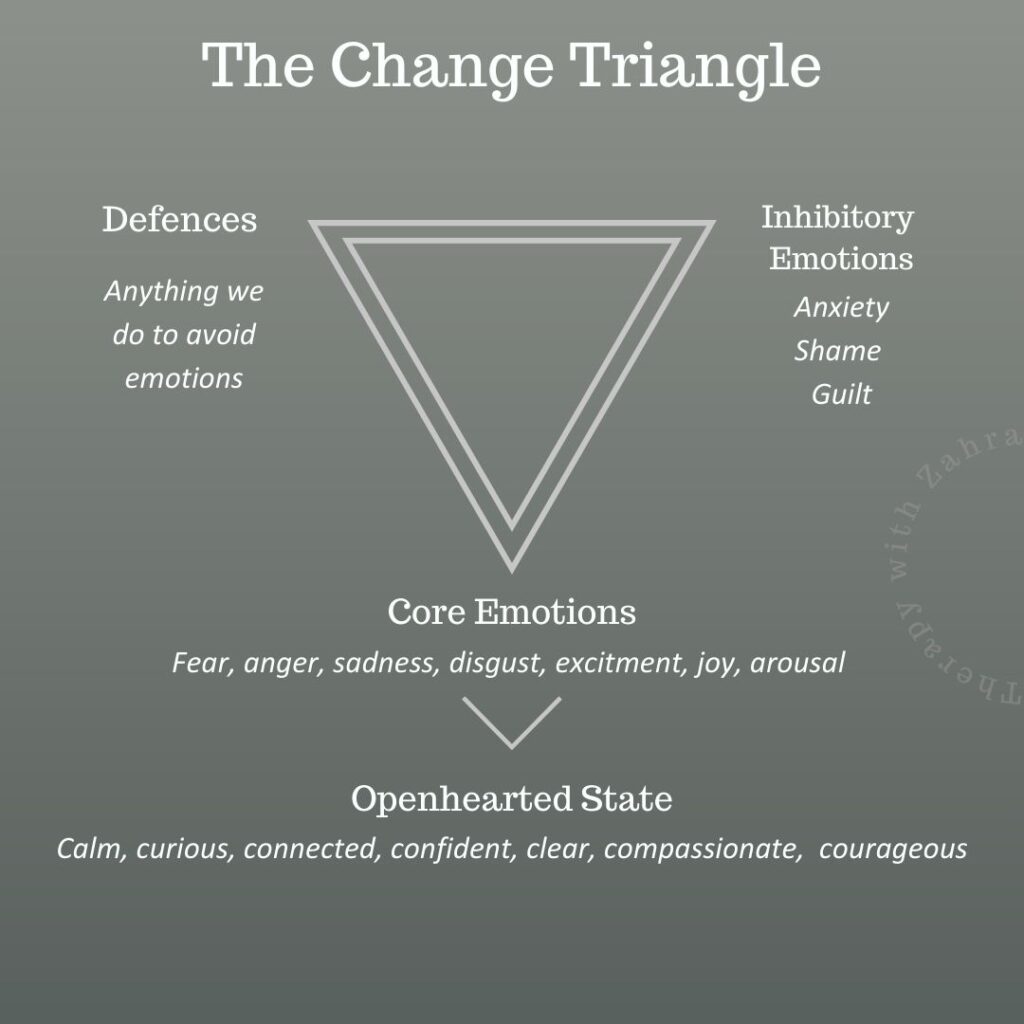
The Change Triangle is a framework for understanding how we experience, manage, and sometimes protect ourselves from emotions.
Rooted in Accelerated Experiential Dynamic Psychotherapy (AEDP), it helps us recognize what might be happening beneath our immediate emotional reactions. The model distinguishes between three categories: defenses, inhibitory emotions, and core emotions.
Beneath the triangle is what Hendel calls the openhearted state, characterized by greater calm, curiosity, compassion, clarity, and connection. Rather than viewing certain emotional responses as inherently problematic, the Change Triangle invites us to become curious about their purpose.
Why might we become anxious when we’re angry? Why do we sometimes feel guilty for expressing our needs? And why might we turn to thinking, distraction, or emotional withdrawal when something becomes uncomfortable?
Let’s explore these questions.
1. Defences
We all have ways of managing experiences that feel uncomfortable, threatening, or overwhelming. Some people withdraw. Others become unusually agreeable, intellectualize their experiences, distract themselves with work, or turn to self-criticism. These responses are sometimes described as defenses. Although the word can sound negative, defenses often serve an important protective function.
Imagine growing up in an environment where expressing anger regularly led to conflict or rejection. You might learn to suppress your frustration, agree with others, or avoid confrontation altogether. Over time, this way of responding may become so familiar that you barely notice it. What began as a way of preserving safety or connection may eventually become your automatic response, even in relationships where expressing disagreement would be possible.
This doesn’t mean that every defense comes from childhood or that defenses are inherently harmful. Sometimes, setting aside our feelings temporarily allows us to function. We may need to remain composed during a difficult conversation or postpone processing an upsetting experience until we have more time and privacy.
The difficulty arises when these protective responses become so automatic that they limit our ability to recognize what we’re feeling or respond flexibly. The question isn’t simply how to get rid of our defenses. It might be more useful to ask: What is this response helping me manage, and is it still serving me in the way I need?
2. Inhibitory Emotions
Have you ever felt guilty for being angry with someone you love? Or experienced shame after expressing a need, even though there was nothing unreasonable about what you asked for? These experiences can be understood through what the Change Triangle calls inhibitory emotions: anxiety, shame, and guilt.
Within this framework, inhibitory emotions can interfere with our ability to recognize and experience other emotions.
Consider someone who grew up believing that expressing sadness was a sign of weakness. As an adult, they may still experience sadness when hurt or disappointed. Yet, almost immediately, another response might emerge: embarrassment, self-criticism, or anxiety about appearing vulnerable.
The sadness hasn’t necessarily disappeared. Instead, the person may have learned that allowing themselves to experience or express it carries some risk.
This is one reason our emotional reactions can sometimes seem contradictory.
We might long for closeness while feeling anxious when someone gets too close. Or feel angry about being mistreated yet immediately feel guilty for having that reaction.
Importantly, not all anxiety, shame, or guilt is simply covering another emotion. These feelings can also be understandable responses to our circumstances, values, or relationships. The invitation is to become curious about whether something else might be present alongside them.
3. Core Emotions
At the base of the Change Triangle are seven core emotions: fear, anger, sadness, disgust, joy, excitement, and sexual excitement. These emotions are understood as fundamental responses that help us navigate our experiences and respond to what matters to us.
Fear may alert us to danger. Anger may signal that a boundary has been crossed. Sadness can accompany loss, while joy and excitement may draw us toward meaningful experiences.
Of course, emotions don’t always provide an accurate interpretation of what’s happening around us.
We can feel afraid when we’re objectively safe. We can feel angry when we’ve misunderstood someone’s intentions. Our emotions offer information, but that information still needs context. This is an important distinction. Making room for an emotion doesn’t necessarily mean agreeing with the story we tell ourselves about it, nor does it mean acting on every impulse that accompanies it.
We can recognize anger without becoming aggressive. We can acknowledge fear without allowing it to determine every decision. Sometimes, recognizing an emotion gives us more room to choose how we want to respond.
What happens when we make room for our emotions?
Hendel describes an openhearted state that can emerge when we’re able to recognize and process our emotional experiences. It’s a state associated with feeling more grounded, connected, curious, and compassionate toward ourselves and others.
You might recognize moments like this in your own life. Maybe you’ve had a difficult conversation in which you finally expressed something you’d been holding back. Or you’ve allowed yourself to grieve a loss rather than immediately distracting yourself.
There may have been a moment afterward when you felt a little more settled or understood something about yourself more clearly. Of course, this isn’t always what happens.
Sometimes, sitting with an emotion brings up more questions. Sometimes, our feelings remain intense, confusing, or difficult to tolerate. For people with histories of trauma or overwhelming experiences, turning inward can occasionally feel destabilizing rather than reassuring.
The aim isn’t to force ourselves to experience emotions before we’re ready or to reach a particular emotional state.
It’s to develop a more flexible relationship with our internal experiences, including recognizing when we need support, distance, or time.
The Change Triangle in Everyday Life
Consider a familiar situation.
You’ve had a demanding week, and a friend asks you for a favor. You’re exhausted and would prefer to rest, but you immediately agree. Later, you find yourself irritated with your friend. You might even begin mentally listing all the times you’ve helped them and wondering why they never seem to consider your needs. What might be happening?
Could your irritation reflect anger about having agreed to something you didn’t want to do? Maybe saying no brings up guilt or anxiety about disappointing someone? Could agreeing automatically have become a way of avoiding those uncomfortable feelings?
Through the lens of the Change Triangle, you might begin to notice several experiences unfolding together. There may be a genuine need for rest, anger about your limits being stretched, guilt about disappointing someone, and a familiar tendency to prioritize another person’s needs. None of these experiences needs to be judged. Instead, you might become curious about what each is communicating.
You might discover that your irritation isn’t only about your friend’s request. It may also have something to do with how difficult it feels to acknowledge and communicate your own limits. That awareness doesn’t instantly change the pattern, but it may create an opportunity to respond differently the next time.
Utilizing the Change Triangle Outside of Therapy
One of the things I appreciate about the Change Triangle is that it provides a way to organize experiences that can otherwise feel confusing.
I’ve found its visual representation useful when navigating strong emotions. Sometimes, simply imagining the triangle helps me consider whether I’m experiencing a core emotion, an inhibitory emotion, or a response that may be protecting me from something uncomfortable. But I also think it’s important not to turn emotional awareness into another task we have to perform correctly.
You don’t have to identify every feeling, understand its origins, or immediately know what to do with it. Sometimes, you may not even know what you’re feeling.
If you’d like to experiment with the Change Triangle, you could begin by asking yourself a few questions:
- What am I noticing in myself right now?
- Is there an emotion I can recognize, even if I can’t fully explain it?
- Am I trying to move away from something uncomfortable?
- What might this response be helping me manage?
- What would I need to approach this experience with a little more curiosity?
You might notice sensations in your body, thoughts, impulses, or nothing particularly distinct. All of these observations can be useful starting points. And if paying attention to your internal experience becomes overwhelming, it’s reasonable to pause, orient yourself to your surroundings, or seek support.
Final Thoughts
We often approach difficult emotions as though they’re problems that need to be fixed. We want to stop feeling anxious, get rid of anger, overcome sadness, or silence the inner critic. And understandably so. Some emotional experiences can be deeply uncomfortable.
But what if, occasionally, we approached our emotional lives with a little less urgency to change what we’re feeling and a little more curiosity about why it might be there? Maybe some of our reactions are attempts to protect us. Others may be communicating needs we’ve struggled to acknowledge, or experiences we haven’t yet made sense of.
Not every emotion has a hidden meaning, and not every emotional response requires extensive exploration.
Sometimes we’re tired, stressed, disappointed, or simply having a difficult day.
Still, learning to recognize our emotional experiences, rather than immediately dismissing or reacting to them, can offer us another way of understanding ourselves.
Until next time,
Zahra